




Over the years, Klaviyo has built a strong reputation as a go-to platform for B2C and e-commerce brands. In the past decade, we’ve worked with more than 100 such businesses that rely on Klaviyo to power their marketing. Each year, we launch and manage over 1,000 campaigns and automations within the platform.
Well, there’s no denying Klaviyo’s popularity as a B2C-first email marketing solution.
However, it’s not the right fit for everyone. For many, cost is a major concern, especially after multiple price increases in recent years.
It can also feel out of reach for smaller teams or early-stage brands operating on tighter budgets.
So, if you’re considering switching, here are 9 best Klaviyo alternatives worth trying.
Table of Contents
9 best Klaviyo alternatives
1. Omnisend
2. HubSpot
3. Maestra
4. MailerLite
5. Privy
6. ActiveCampaign
7. Campaign Monitor
8. GetResponse
9. Yotpo
Choosing from Klaviyo competitors: Our verdict
Need help switching to Klaviyo competitors?
9 best Klaviyo alternatives
1. Omnisend

Omnisend is arguably the best alternative to Klaviyo. Here’s what stands out:
- Unlike Klaviyo, Omnisend includes Web Push Notifications natively. You can easily build workflows that combine email, SMS, and browser push without extra apps.
- It includes built-in interactive features like “Wheel of Fortune” signup forms that typically require a third-party app (like Justuno or Privy) in Klaviyo.
- The “Product Picker” allows you to drag products directly from your store into an email with pricing and links automatically populated.
- Omnisend is 15-40% cheaper than Klaviyo as your list grows.
Omnisend: Pros & cons
| Pros | Cons |
| Built specifically for ecommerce with deep Shopify, WooCommerce & BigCommerce integrations | SMS can become expensive at high sending volumes |
| Generous free plan with automation + 24/7 live chat support | Charges based on billable contacts, including certain non-subscribers |
| Strong pre-built automation workflows (cart, welcome, post-purchase, etc.) | Smaller template library compared to some competitors |
| Seamless multi-channel flows (Email + SMS + Web Push in one automation) | Fewer integrations than larger platforms like Mailchimp or Klaviyo |
| Revenue-focused reporting with clear attribution tracking | Advanced testing and deliverability tools are limited |
Read our full comparison of Omnisend vs. Klaviyo.
2. HubSpot
HubSpot is an all-in-one platform, not limited to e-commerce like Klaviyo. It can be a better fit for your e-commerce business depending on your peculiar needs as one:
- Since it’s an all-in-one platform, HubSpot replaces your email tool, your CRM, your help desk (Service Hub), and also your website builder (CMS Hub).
- HubSpot excels at scoring leads based on non-purchase behavior.
- If your strategy relies heavily on SEO and blogging, HubSpot’s integrated CMS and SEO tools are world-class.
- While HubSpot’s entry plans are attractively priced, accessing automation capabilities comparable to Klaviyo requires upgrading to Marketing Hub Professional, which starts at around $800+ per month, along with a mandatory onboarding fee.
HubSpot: Pros & cons
| Pros | Cons |
| All-in-one platform unifying marketing, sales, service, content, operations, and commerce | Premium features and advanced tools can become expensive |
| User-friendly interface with clean layout and helpful tutorials | Costs scale with contacts, features, and team size |
| Free CRM plan with robust core features | Annual contracts can feel rigid and limit flexibility |
| Highly scalable; easy to upgrade without migrating systems | Third-party integrations may require extra setup |
| Strong automation, analytics, AI tools (Breeze), and reporting. | Advanced automation and customization are locked behind higher tiers |
| Modular pricing, buy only the hubs you need | Full ecosystem can become costly for growing teams |
| Deep ecosystem integration across hubs via Smart CRM | May be overkill for businesses with simple needs |
| Payment tools via Commerce Hub (Stripe, QuickBooks integration) | Plays best within its own ecosystem vs. external tools |
3. Maestra
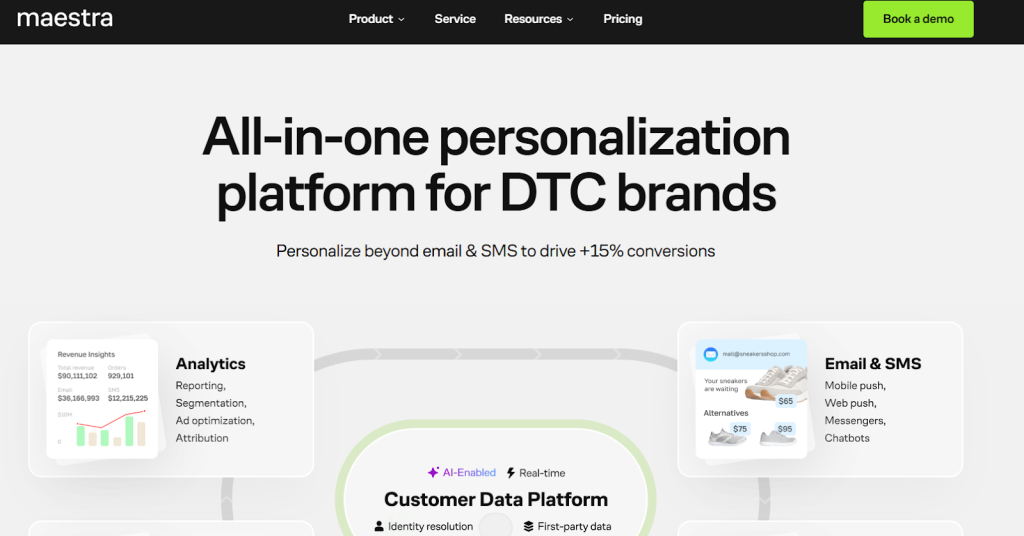
Like Klaviyo, Maestra is a dedicated platform for e-commerce. Here’s what stands out:
- Maestra is an all-in-one Customer Data Platform (CDP). It builds Loyalty, Referrals, Site Personalization (banners/pop-ups), and Omnichannel messaging into a single interface.
- Since Maestra includes loyalty and referral engines, you can often cancel subscriptions to tools like Yotpo, Smile, or ReferralCandy.
- Maestra is famous for its White-Glove Support. Every client gets a dedicated Customer Success Manager who actually builds your flows and handles the migration for you.
Maestra: Pros & cons
| Pros | Cons |
| Robust CDP captures data from every customer interaction, enabling smarter automation and personalization | Limited pre-made email templates compared to some competitors |
| Advanced automation beyond campaigns (promotions, loyalty, dynamic content, recommendations, segmentation) | Greater reliance on custom-built templates during onboarding |
| Deep personalization: dynamic content, conditional blocks, targeted pop-ups, and tailored offers | Users who prefer ready-made email/flow templates may find options limited |
| Consolidates multiple tools (automation, CDP, loyalty) into one unified retention platform | May require external inspiration/tools for more diverse email designs |
| “White glove” service with a dedicated CSM for strategy, setup, and ongoing support |
4. MailerLite
Compared to Klaviyo, MailerLite is simpler, cheaper, and more user-friendly. If you’re a brand that wants to do good email marketing, MailerLite is your thing. Here’s why:
- MailerLite includes a full Landing Page and Website Builder. You can actually build your entire digital presence and sell digital products directly through MailerLite.
- It is arguably the easiest platform to navigate. That’s a major win for starters.
- MailerLite has a notoriously strict approval process for new accounts, which in 2026 has resulted in some of the highest inbox-placement rates in the industry.
- MailerLite is approximately 3x cheaper than Klaviyo as you scale.
MailerLite: Pros & cons
| Pros | Cons |
| Clean, simple, beginner-friendly interface | Limited landing page templates (around 26 available) |
| Intuitive drag-and-drop editor for emails, forms, and landing pages | Landing pages not as advanced as dedicated funnel builders |
| Flexible email creation (drag & drop, rich text, custom HTML) | Signup forms and landing pages are functional but not visually standout |
| Smart Sending feature optimizes send times automatically | Not designed for highly complex funnel builds |
| Strong automation builder with templates, delays, conditions, A/B testing | Advanced features (e.g., Smart Sending, integrations) require higher-tier plans |
| Built-in popups, embedded forms, and promotions | |
| Landing page and basic website builder included | |
| Generous free plan (up to 1,000 subscribers) | |
| Affordable pricing with unlimited emails on paid plans | |
| 10% discount for annual billing |
5. Privy
While not as popular as Klaviyo in the e-commerce world, Privy can be the perfect fit if you are a small-to-medium Shopify store focused on growth. But apart from that:
- Privy can trigger emails when someone adds an item to their cart but doesn’t even reach the checkout page. Many standard tools (including Klaviyo’s basic setup) often focus only on Abandoned Checkout.
- Many of Privy’s plans allow for unlimited email sends, which is a massive win for brands that like to send frequent newsletters without worrying about overage fees.
- Like Maestra, Privy also has white-glove support for smaller brands, offering e-commerce coaching and webinars to help you actually sell, not just use the software.
- The platform’s Convert suite includes gamified pop-ups, free shipping bars that update in real-time, and cross-sell displays that show up while a customer is shopping.
Privy: Pros & cons
| Pros | Cons |
| More affordable than Klaviyo | Reporting lacks deep analytics and advanced time-frame comparisons |
| Free plan available (up to 100 mailable contacts) | Limited ability to drill down into customer-level data |
| Simpler, beginner-friendly interface | Fewer and less sophisticated email templates compared to larger platforms |
| Straightforward drag-and-drop email editor | Pop-up design variety is more limited |
| Strong pop-up functionality (original core strength) | Multi-step pop-ups require separate forms and manual linking |
| Unique countdown timer and free shipping bar pop-up features | Fewer native and third-party integrations |
| Suitable for small and growing ecommerce brands | May not be ideal for complex marketing automation or enterprise needs |
| Basic but sufficient campaign and flow reporting | Harder to compare performance across time periods |
| Integrates with major ecommerce platforms | Less robust ecosystem compared to larger competitors |
| Attractive migration offers (e.g., discounts for switching) | May not scale well for large or fast-growing brands |
6. ActiveCampaign
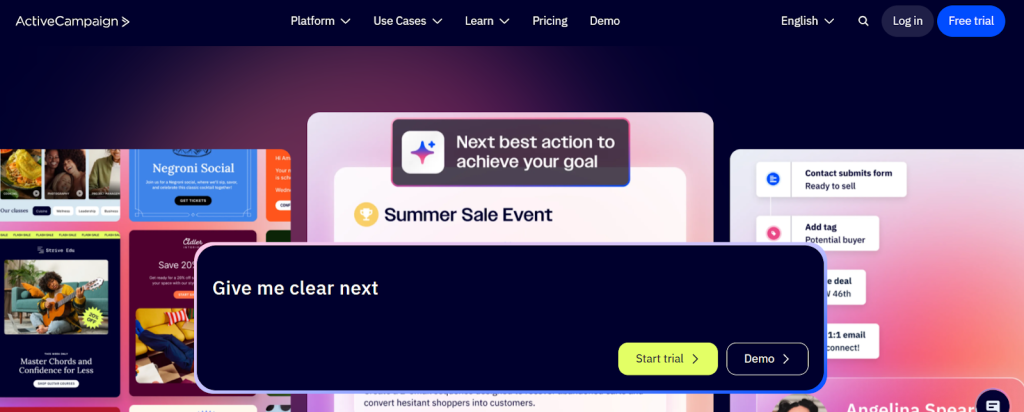
As a marketing automation platform, ActiveCampaign is hard to rival. Make no mistake, Klaviyo is great at automation, but it still falls far short of ActiveCampaign:
- The platform’s automation builder is arguably the most flexible on the market. You can create complex if-else branches based on site visits, link clicks, contact tags, location, etc.
- Unlike Klaviyo, it has a built-in CRM with drag-and-drop deal pipelines.
- ActiveCampaign is great for e-commerce, integrating with Shopify and WooCommerce, along with more than 900 third-party integrations.
- You can build highly complex automation flows on a very user-friendly builder. Add to that over 900 customizable workflow templates.
ActiveCampaign: Pros & cons
| Pros | Cons |
| Industry-leading automation builder with deep logic, behavioral triggers, site & event tracking | Not beginner-friendly; a steep learning curve |
| Create automations directly from newsletters (open/click-triggered workflows in one click) | Interface can feel complex due to depth of features |
| Huge library of triggers, actions & automation recipes | Pop-up forms lack exit-intent & time-delay triggers (scroll only) |
| Advanced A/B testing inside automations (conditional splits, path limits, discount caps) | Some advanced automation testing not available on lower plans |
| Built-in CRM with pipelines, deal tracking, lead scoring & sales reporting | Overkill for simple newsletter-focused users |
| CRM actions fully integrated inside automation builder | Best value only if you fully utilize advanced automation & CRM features |
| Strong automation reporting with date comparisons & performance tracking | Basic email & form editors; functional but not highly advanced |
| Automation map to visualize how workflows connect | No free plans available |
| Strong landing page & form builder with deep customization & CSS control | |
| Strong ecommerce automation (cart triggers, product behavior, revenue reporting) | |
| Excellent customer support response times (very fast replies reported) |
7. Campaign Monitor
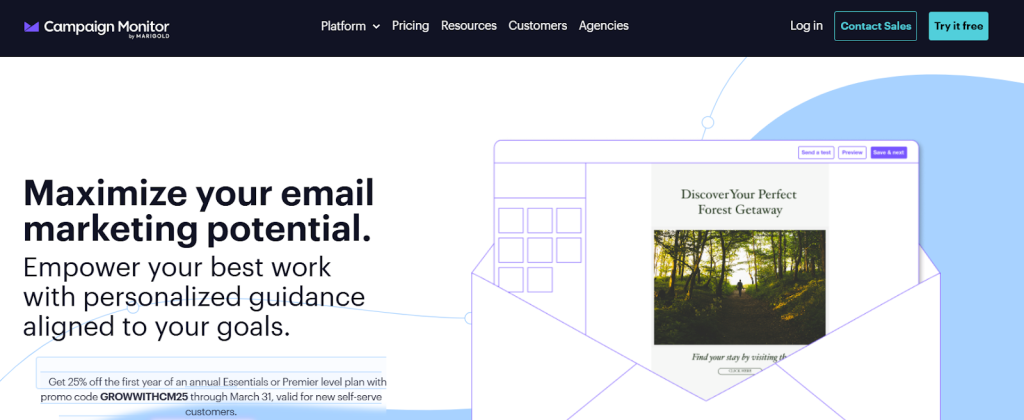
Campaign Monitor blends sophisticated capabilities with a refreshingly simple user experience, making professional email marketing easy to execute. Here’s why it stands out:
- Their drag-and-drop editor is cited as the smoothest in the industry. It feels less clunky than Klaviyo’s and handles custom fonts and complex layouts with more grace.
- If you run an agency, Campaign Monitor allows you to rebrand the entire platform as your own, set your own prices, and bill your clients directly through the interface.
- You can plug in your website URL, and Campaign Monitor will automatically pull your logo, brand colors, and fonts to create a custom template for you in seconds.
- Campaign Monitor is less expensive than Klaviyo. It uses a mix of subscriber-based and send-based pricing. For a list of 10,000 contacts, you’ll pay roughly $110–$150/month, depending on features.
Campaign Monitor: Pros & cons
| Pros | Cons |
| Transparent “pay-as-you-grow” pricing with no surprise setup fees | Advanced features require upgrading to higher-tier plans |
| Beginner-friendly, intuitive interface with fast setup | Not built for highly complex, multi-step automation workflows |
| Large library of visually polished templates | Primarily focused on email; limited multi-channel capabilities |
| Strong segmentation and dynamic content options | Automation capabilities are basic compared to enterprise platforms |
| Real-time reporting with opens, clicks, conversions, and GA integration | No native CRM |
| Responsive customer support | Community/forums less active than larger platforms |
| Ideal for small to mid-sized businesses | May not scale well for businesses needing full marketing orchestration |
8. GetResponse
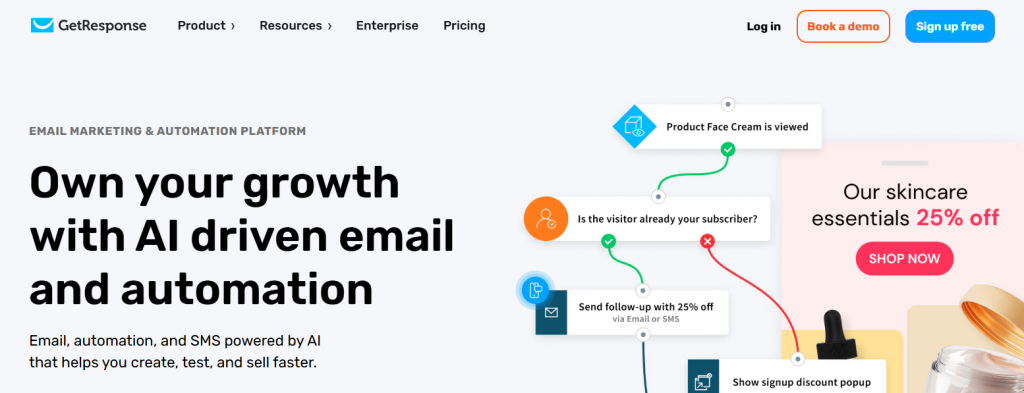
GetResponse is predominantly for digital content creators. But it is not a bad fit for e-commerce. It offers cart abandonment workflows, promo codes, transactional emails, and more:
- The platform’s Price Drop Campaigns is a standout native feature that automatically alerts browsers when a product they viewed has a price drop.
- If your e-commerce brand relies on education (e.g., selling fitness gear + fitness courses, or kitchenware + cooking webinars), GetResponse is the clear winner. You can host live events and sell digital content without third-party apps.
- Its pre-built funnels combine landing pages, signup forms, and email sequences into one visual flow, making it much easier for beginners to launch a campaign.
- Significantly more affordable than Klaviyo. At the 10,000-contact mark, the platform is 60% cheaper than Klaviyo while offering unlimited monthly sends on most plans.
GetResponse: Pros & cons
| Pros | Cons |
| Long-standing platform (est. late 1990s) with proven reliability | Editor isn’t as advanced as dedicated funnel builders (e.g., not built to rival full funnel platforms) |
| Built-in landing page builder (AI-powered or drag-and-drop) | Advanced e-commerce and creator features require higher-tier plans |
| Large selection of landing page and email templates | May lack deep, enterprise-grade complexity for advanced marketers |
| Beginner-friendly, intuitive interface across landing pages, emails, and newsletters | Higher-level features (webinars, automation, courses) cost more |
| Powerful autoresponder system with multi-day automation sequences | AI tools are optional and may not appeal to users who prefer manual control |
| Unlimited autoresponders (even on Starter plan) | Not positioned as a full all-in-one CRM ecosystem |
| Unlimited monthly email sends | |
| Built-in spam check feature before sending emails | |
| 24/7 chat support with responsive service | |
| AI subject line and email generator options | |
| Affordable entry pricing (Starter plan around $19/month for 1,000 contacts) | |
| Additional features available: abandoned cart recovery, promo codes, webinars, course creation (higher tiers) | |
| Easy newsletter scheduling or immediate sending |
9. Yotpo
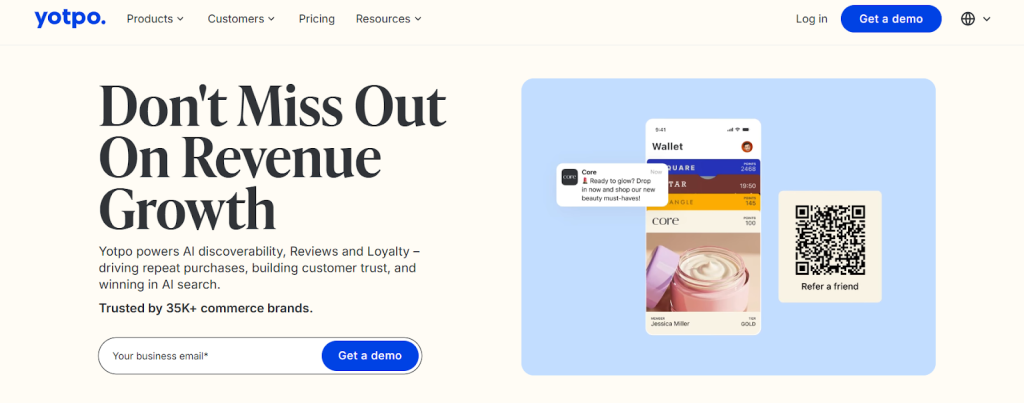
Yotpo is primarily known as a loyalty-first platform, but it is a popular alternative to Klaviyo when it comes to e-commerce. Here’s how Yotpo stacks up:
- Yotpo’s loyalty engine is vastly superior to Klaviyo’s new internal review tool. You can create complex VIP tiers and redeem-at-checkout experiences that Klaviyo can’t replicate natively. At least not yet.
- Yotpo’s Premium bundles can actually save you money by replacing 3-4 separate app subscriptions.
- Even mid-sized brands get a dedicated strategist to help them build their retention plan on Yotpo, whereas Klaviyo is largely DIY.
Yotpo: Pros & cons
| Pros | Cons |
| Strong focus on customer reviews. Built specifically for review collection and marketing | Pricing can be expensive, especially for small businesses |
| Easy review collection and display on your website | Advanced features require higher-tier plans |
| User-generated content (UGC) support with customer photos and testimonials | |
| Built-in loyalty and rewards programs to encourage repeat purchases | |
| Unique marketing approach focused on reviews and retention rather than traditional email-first strategy |
Choosing from Klaviyo competitors: Our verdict
The list above isn’t exhaustive. There are several other e-commerce platforms such as Volusion, Sellfy, Magento, and Ecwid that also integrate with leading ESPs.
But when it comes to Klaviyo competitors and alternatives, the primary motivation is usually cost reduction. For that reason, we placed Yotpo at the end of our list. While it’s a powerful and credible competitor, it tends to be priced closer to Klaviyo, which may not suit brands looking for a more budget-friendly option.
Out of the nine alternatives reviewed, our strongest recommendations are:
- Omnisend: More affordable than Klaviyo, while still offering robust automation and multichannel capabilities.
- Maestra: Stands out for its white-glove onboarding and hands-on support, which can be a major advantage during migration.
- Privy: It differentiates itself with gamified popups, advanced cart recovery flows, and competitive pricing well below Klaviyo’s typical tiers.
We encourage you to evaluate multiple options before making a decision. As you research any Klaviyo alternative or e-commerce marketing platform, prioritize:
- Ease of use
- Seamless integrations
- Strong automation capabilities
Need help switching to Klaviyo competitors?
Campaigns are easy to move, but flows aren’t. Complex automations with layered triggers, filters, and logic can create serious migration friction. SMS makes it tougher. You can’t run two providers at once, so switching requires a full cutover with no parallel testing.
Add to these the risk of a dip in performance mid-switch.
Even when automations are replicated accurately, performance can vary across platforms. The uncertainty around matching historical results and the possibility of a short-term revenue dip is a valid concern.
If you’re planning a migration from Klaviyo and need expert guidance, we can help you manage the transition smoothly. Get in touch to learn how we can support your move.