


You ordered a thoughtful gift for someone’s birthday two weeks ago. The tracking number hasn’t been updated in five days. You are anxious, frustrated, and running out of time. You finally send a support ticket asking where the package is.
The moment brands get tone-deaf, customers decide they’re done.
We have all experienced it. It is the specific, sinking feeling of a relationship with a brand breaking, not because the product failed, but because the communication failed.
A support bot acknowledges the ticket with a generic, cold auto-response: “We have received your request.”
Three minutes later, your phone buzzes. It is an email from the exact same brand. The subject line reads: “Don’t miss out! 20% off our newest arrivals!”In that split second, the disconnect hits you. The marketing team is doing its job (sending scheduled campaigns). The support team is doing its job (queueing tickets). But you feel completely unseen. You feel like a data point in a revenue model, not a human being with a problem.
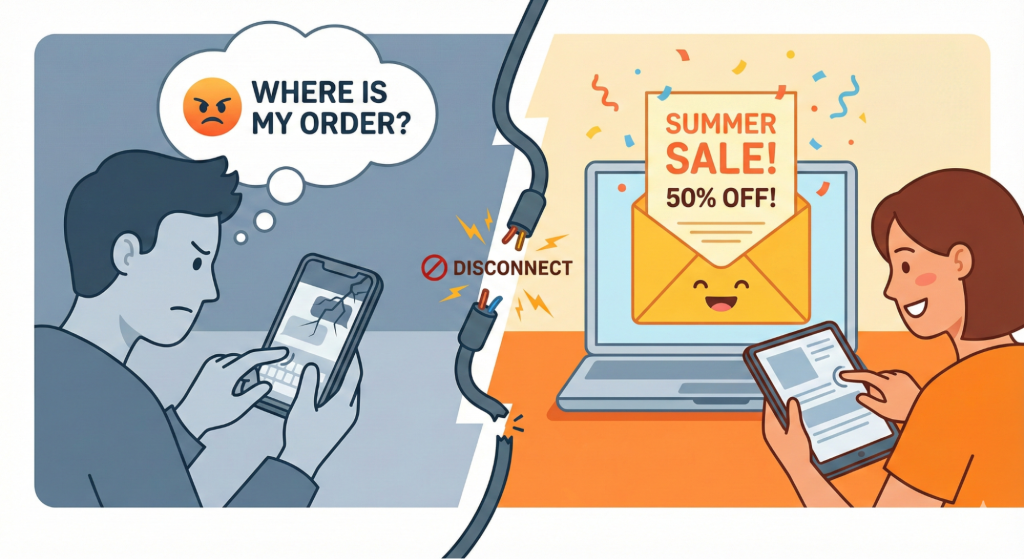
This is where churn happens.
Most customer churn isn’t caused by bad products. Churn happens because brands fail emotionally at critical moments. When a customer is vulnerable, frustrated, or seeking help, silence is bad, but tone-deaf noise is unforgivable.
Klaviyo’s Smart Sentiment Analysis marks a turning point in this dynamic. It is the technological shift in which AI enables brands to understand customer mood in real time and respond with empathy, not automated noise.
We are moving from reactive support and isolated marketing to a coordinated, sentiment-aware customer experience.
Let’s cut to the chase and unveil the latest AI features of Klaviyo’s smart sentiment analysis.
| Why sentiment has become the missing layer in customer experience Historical disconnect between support and marketing Everything about Klaviyo smart sentiment analysis How Klaviyo detects customer mood in real time Automatic ticket routing: Right issue, right team, right moment Where sentiment analysis changes everything: The marketing connection Use cases across e-commerce and CX teams Deliverability benefits most teams overlook Operational impact for CX and CRM leaders How marketing teams benefit without losing revenue Governance and best practices for sentiment-driven automation Measuring success in a sentiment-aware system Why sentiment intelligence is the future of customer experience |
Why sentiment has become the missing layer in customer experience
For too long, businesses have treated the customer journey as a linear, logical progression. We map it out on whiteboards: Awareness > Consideration > Purchase > Retention.
But the reality of the customer experience is emotional, not linear. Purchases might be driven by logic, but loyalty is driven by emotion. Frustration escalates infinitely faster than satisfaction builds. A single moment of neglect can erase years of brand equity.
The problem is that the traditional tools we use to measure customer happiness are often too slow to catch these emotional shifts before it is too late.
Traditional CX metrics lag behind reality
- CSAT (Customer Satisfaction Score) surveys typically arrive after the interaction is over, after the damage is done.
- NPS (Net Promoter Score) captures a general memory of the brand over time, not the emotion of the specific moment.
- Ticket Volume tells you how many problems exist, but not how customers feel about them.
Marketing automation often amplifies the problem.
When automation runs blindly, it ignores context. Scheduled campaigns continue to fire during complaints, refunds, and escalations. The automation engine doesn’t know the customer is angry; it only knows they are “in the segment.”
The result is predictable and damaging: Increased unsubscribes, spam complaints, and the erosion of trust.
When a customer is shouting for help, a sales pitch feels like an insult. Sentiment is the missing layer that provides the context necessary to stop this damage.
But how did the connection between support and marketing break? Let’s discuss that.
Historical disconnect between support and marketing
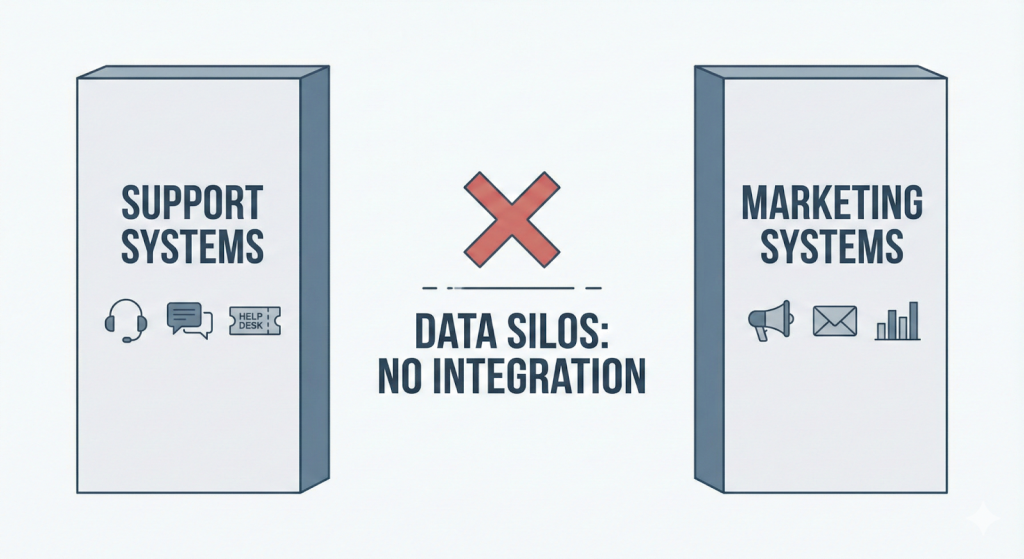
Why has this problem persisted for so long? Why do brands continue to send “Happy Birthday” emails to customers who are in the middle of a refund dispute?
The answer lies in the architecture of our businesses. Our systems were built in silos.
| Support Systems | Marketing Systems |
| Built to resolve issues | Built to drive revenue |
| Ticket-based workflows | Campaign-based workflows |
| Prioritize SLAs and queue management | Prioritize reach, volume, and frequency |
| Measure success by tickets closed | Measure success by conversions and revenue |
| Inherently reactive | Inherently proactive |
| Wait for problems to arrive | Push messages to generate demand |
| Engage after something breaks | Engage before demand exists |
Why do these systems rarely talk to each other?
Historically, these teams have used separate tools, KPIs, and incentives. Marketing is rewarded for clicks and revenue; Support is rewarded for speed and resolution. They rarely share data in real-time.
The cost of operating in these silos is high. It leads to tone-deaf communications, missed recovery opportunities, and customers feeling like “cases” rather than people. The customer doesn’t care about your internal silos; they only see one brand.
Everything about Klaviyo smart sentiment analysis
This is where the new capabilities within Klaviyo Service change the game. It bridges the gap between the support ticket and the marketing flow using artificial intelligence.
What Klaviyo smart sentiment analysis is
It is an AI-powered capability embedded directly within Klaviyo’s Service product. It is designed to:
- Analyze incoming customer messages in real time as they arrive.
- Detect emotional tone (Positive, Neutral, Negative).
- Classify urgency and intent instantly.
What is it not?
It is vital to clarify that this is not simple keyword tagging. It isn’t just looking for the word “angry” or “bad” in a subject line. It is not a manual labeling system where support agents have to click a dropdown menu to flag a user. It is not a static, rules-based system that requires constant maintenance.
Why does this matter now?
Support volumes are rising across every industry. Customers expect immediacy and empathy. Manual sentiment detection, expecting a human agent to read every email before prioritizing it, simply does not scale. You cannot hire enough humans to read every message instantly. You need AI to listen at scale.
How Klaviyo detects customer mood in real time
For the technical and operational leaders, understanding the mechanics of this feature is crucial to trusting it. How does the engine actually know a customer is upset?
Let me show you three quick and effective ways in which Klaviyo does it.
1. Signals analyzed by the AI
The AI parses incoming communications for multiple layers of context, moving far beyond basic keywords:
- Language Patterns: Is the phrasing direct, passive, or aggressive?
- Emotional Cues: Is there underlying frustration, gratitude, confusion, or sarcasm?
- Urgency Markers: Is the customer using words like “immediately,” “ASAP,” “today,” or “ruined”?
- Repetition and Escalation Tone: Are they repeating themselves? Repetition is a key indicator of rising frustration.
2. From raw messages to sentiment classification
Whether the input is an email, a live chat transcript, a support form, or an in-app message, the system ingests the raw text. It processes this unstructured data and assigns a structured sentiment classification instantly.
3. Confidence scoring and continuous learning
Sentiment isn’t binary. A customer can be “frustrated but polite” or “angry and urgent.” The AI adapts as language patterns evolve. Its accuracy improves with volume, learning the specific nuances of your customer base and how they communicate.
Automatic ticket routing: Right issue, right team, right moment
The first major benefit of sentiment analysis is increased operational efficiency within the support team. It acts as an intelligent triage nurse for your helpdesk.
Here are three benefits automatic ticket routing brings to the table.
- Routing based on emotional urgency
Not all tickets are created equal. A “Where is my order?” ticket is different from a “This product ruined my event” ticket, even if they both relate to shipping.
With Smart Sentiment Analysis, angry or high-risk customers are prioritized automatically. You don’t need a human triage agent to read the ticket first. The AI flags it as “Negative Sentiment” and routes it to your escalation team or senior agents immediately.
2. Reducing manual triage for support teams
This drastically reduces the time agents spend categorizing and tagging. It frees them to spend more time resolving complex issues and less time doing administrative work.
3. Preventing burnout in support operations
By creating clear prioritization, agents suffer less emotional overload. They know that the queue is organized by urgency and sentiment, not just random arrival time. It allows teams to brace themselves for difficult tickets and breeze through the easy ones, rather than being blindsided.
So, does Klaviyo’s smart sentiment analysis change everything? Let’s find out.
Where sentiment analysis changes everything: The marketing connection
Here is the core differentiator. Klaviyo unifies Service and Marketing into one platform. Sentiment data doesn’t just stay in the helpdesk; it informs the marketing engine.
Suppressing promotional flows during negative sentiment does the job.
This is the “kill switch” for tone-deafness. It solves the “Happy Birthday during a dispute” problem.
You can set up logic that says: IF a customer has an open ticket with “Negative Sentiment,” THEN automatically pause:
- Sales emails.
- Upsell campaigns.
- Product recommendation flows.
- SMS blasts.
Why does this protect the brand?
This simple logic protects brand perception. No more discounts during disputes. No “celebratory” messaging during moments of frustration. It respects the customer’s emotional state.
How does this directly reduce spam complaints?
When a frustrated customer receives a marketing email, they often mark it as spam out of spite. It is an emotional reaction. By suppressing these emails during sensitive windows, you reduce spam complaints, protecting your sender reputation and deliverability for the entire list.
Triggering recovery and “surprise and delight” flows
We can move beyond damage control (suppression) and into active recovery (engagement).
First, you need to turn negative moments into loyalty moments. You can trigger automation flows based on sentiment shifts.
- Apology Emails: An automated, empathetic acknowledgment that their issue is being prioritized.
- Priority Handling Confirmations: Letting them know they have been moved to the front of the line.
- Goodwill Gestures: Unexpected perks that disarm the anger.
Also, here are some examples of recovery automations.
- A Discount Code is sent automatically after a negative ticket is resolved and closed.
- Free Shipping on the next order for a customer who experienced a detected delay.
- A Personal Note triggered from a founder or head of support when sentiment hits a critical low.
But why do recovery flows outperform acquisition campaigns?
Recovery flows have a higher emotional impact. Resolving a negative situation well often creates stronger loyalty than a standard positive transaction. It increases Lifetime Value (LTV) by retaining customers who were about to churn.
Deliverability benefits most teams overlook
Deliverability is often viewed as a technical problem, but it is deeply tied to sentiment.
Emotional spam complaints are the most dangerous.
Spam complaints (clicking “Report Spam”) are rarely about content quality. They are about timing and tone. A customer reports spam when they are annoyed, feeling harassed, or ignored.
Sentiment-aware suppression protects the sender reputation score.
By suppressing marketing during sensitive periods (negative sentiment), you receive fewer complaints. This leads to more consistent engagement signals and better long-term inbox placement stability.
You build trust with mailbox providers (Google, Yahoo) by showing you respect user signals and stop mailing people who are upset.
Operational impact for CX and CRM leaders
For the leaders managing these teams, the impact is measurable and strategic.
- Faster resolution times
Reduced routing friction means tickets get to the right person faster. Resolution time (TTR) drops because tickets aren’t bouncing between departments.
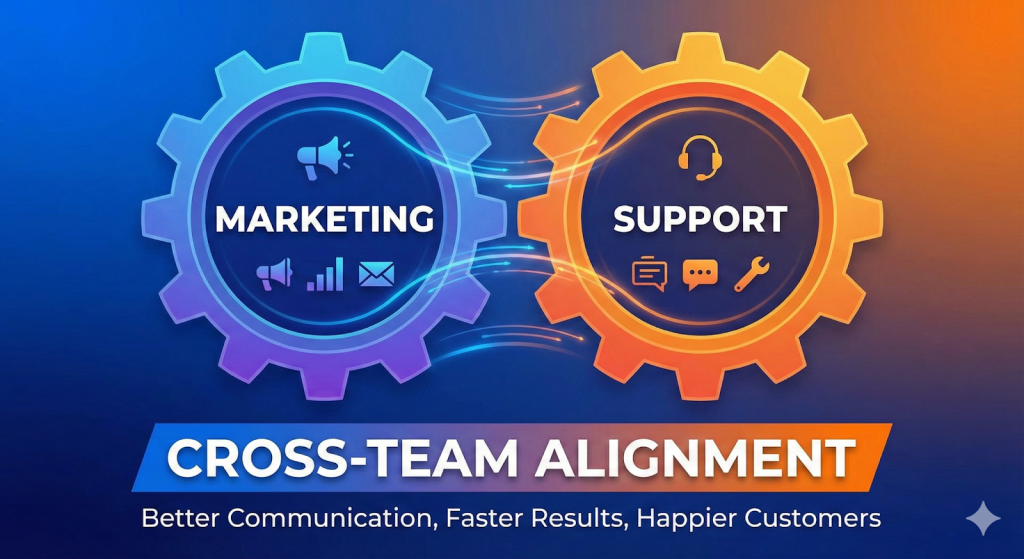
2. Better cross-team alignment
Marketing and Support finally share a brain. They share an understanding of the customer state. Support isn’t cleaning up Marketing’s messes, and Marketing isn’t blind to Support’s reality.
3. Clearer prioritization frameworks
Prioritization becomes data-driven: Emotion + Urgency, not just ticket age (First In, First Out). This ensures the fires are put out first, regardless of when they started.
How marketing teams benefit without losing revenue
A common fear from marketing teams is: “If we suppress emails, won’t we lose sales?”
- Pausing promotions doesn’t hurt growth
Short-term suppression prevents long-term churn. The revenue lost by pausing one email is pennies compared to the revenue lost by a customer unsubscribing forever.
2. Revenue protection through empathy
Customers return when they feel respected. If you blast them while they are angry, they leave. If you pause, fix the issue, and welcome them back, you keep the LTV.
3. Smarter lifecycle orchestration
Marketing becomes context-aware, not silent. You aren’t stopping communication; you are changing the type of communication to match the moment. You are trading a short-term conversion for a long-term relationship.
Governance and best practices for sentiment-driven automation
To deploy this successfully, you need rules of engagement.
- Avoiding overreaction
Not every negative signal requires a “Code Red.” A mild complaint about a color choice doesn’t need to trigger a VP apology or a full marketing blackout. You must set thresholds.
2. Human oversight and review loops
AI assists; humans decide boundaries. You need human oversight to periodically review the AI classifications and adjust the model’s sensitivity.
3. Clear rules for suppression and recovery
Document your logic. When does suppression start? When does it end? Consistent execution builds trust.
But how do you prove the ROI of empathy? Let’s discuss that next.
Measuring success in a sentiment-aware system
There are three key metrics that will help you measure the success of your sentiment-aware system.
- CX metrics
| Metric | What It Indicates |
| Resolution Time | Does it decrease for high-priority tickets? |
| Repeat Complaints | Do customers have to ask twice? |
| Post-Resolution CSAT | Are customers happier after the fix? |
2. Marketing metrics
| Metric | What It Indicates |
| Spam Complaint Reduction | Is the rate dropping? |
| Unsubscribe Rate Trends | Are fewer people leaving during support interactions? |
| Engagement Recovery | Do suppressed customers eventually buy again? |
3. Retention and revenue indicators
| Metric | What It Indicates |
| Repeat Purchase Rate | Among customers who filed support tickets |
| Churn Reduction | Are we retaining more customers who experienced issues? |
| Lifetime Value Lift | Is the LTV of customers with support tickets improving? |
Now, let’s see what the future holds in store for us.
Why sentiment intelligence is the future of customer experience
Automation without empathy is brittle. It breaks under pressure. It scales noise, not value.
AI enables emotional awareness at scale. It allows us to treat one million customers with the same nuance and care as one customer standing in front of us.
The brands that win in the next decade will be the ones that:
- Listen faster.
- Respond smarter.
- Coordinate better.
Sentiment analysis is the foundational layer that enables this.

Wrapping up
Customers don’t expect perfection; they expect awareness.
Klaviyo smart sentiment analysis transforms automation from something customers tolerate into something they trust.
It reframes the relationship. Customers know things go wrong. Packages get lost. Software has bugs. They don’t expect perfection. But they expect you to know when things are wrong. They expect you to read the room.
With this technology:
- Empathy is no longer manual.
- Timing is no longer accidental.
- Support and marketing no longer work in isolation.
We are entering an era in which your software can read your customer’s mood.
Make sure it is listening.